The charger is the easy part. For most Langley homeowners, the work that decides whether an EV charger installation goes smoothly — or stalls for weeks — happens before anyone mounts anything on the wall: the load calculation, the electrical permit and the rebate paperwork. Get those three right and the installation is usually straightforward; get one wrong and you can end up with a charger you cannot run at full power, an unclosed permit, or a refused rebate.
Langley adds its own wrinkles: it is two municipalities, not one — the compact City of Langley around the downtown core, and the much larger Township of Langley around it, covering Willoughby, Walnut Grove, Murrayville, Fort Langley, Aldergrove and Brookswood. The housing stock splits the same way: new Willoughby and Walnut Grove townhomes usually arrive with 200-amp service and a garage, while older Fort Langley, Murrayville and Brookswood homes often still run on 100-amp panels. Permit and rebate rules are the same in both Langleys — but the answers for your house depend on which side of that split you sit on.
This guide walks through the three steps in the order that saves the most time — load calculation first, then permit, then rebate. It is a process guide, not a sales page. For the service itself, see EV charger installation services from Intel Power Electric, and for local coverage, our electrician in Langley page.
How a Load Calculation Works — and Why It Comes First
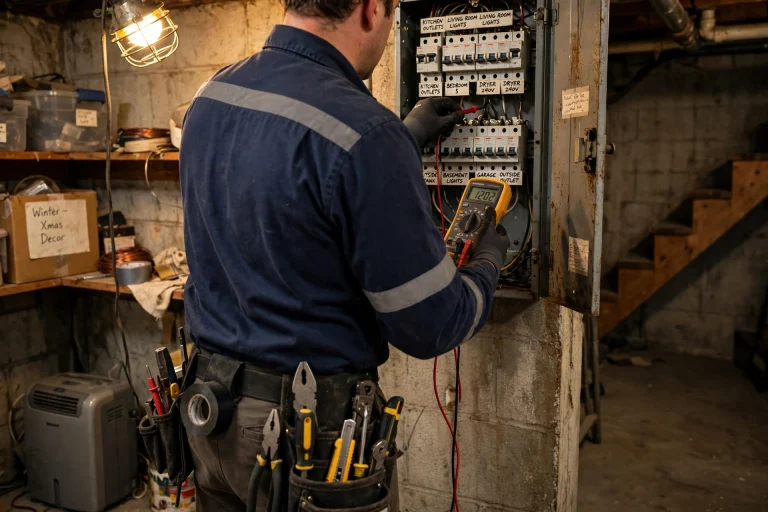
A load calculation is the arithmetic behind a safe installation: a licensed electrician adds up your home’s existing electrical demand, compares it with the size of your service, and works out how much capacity is genuinely left for a charger that will draw power for hours at a time. It answers the only question that matters at the start: can this panel support a Level 2 charger, and if so, at what amperage?
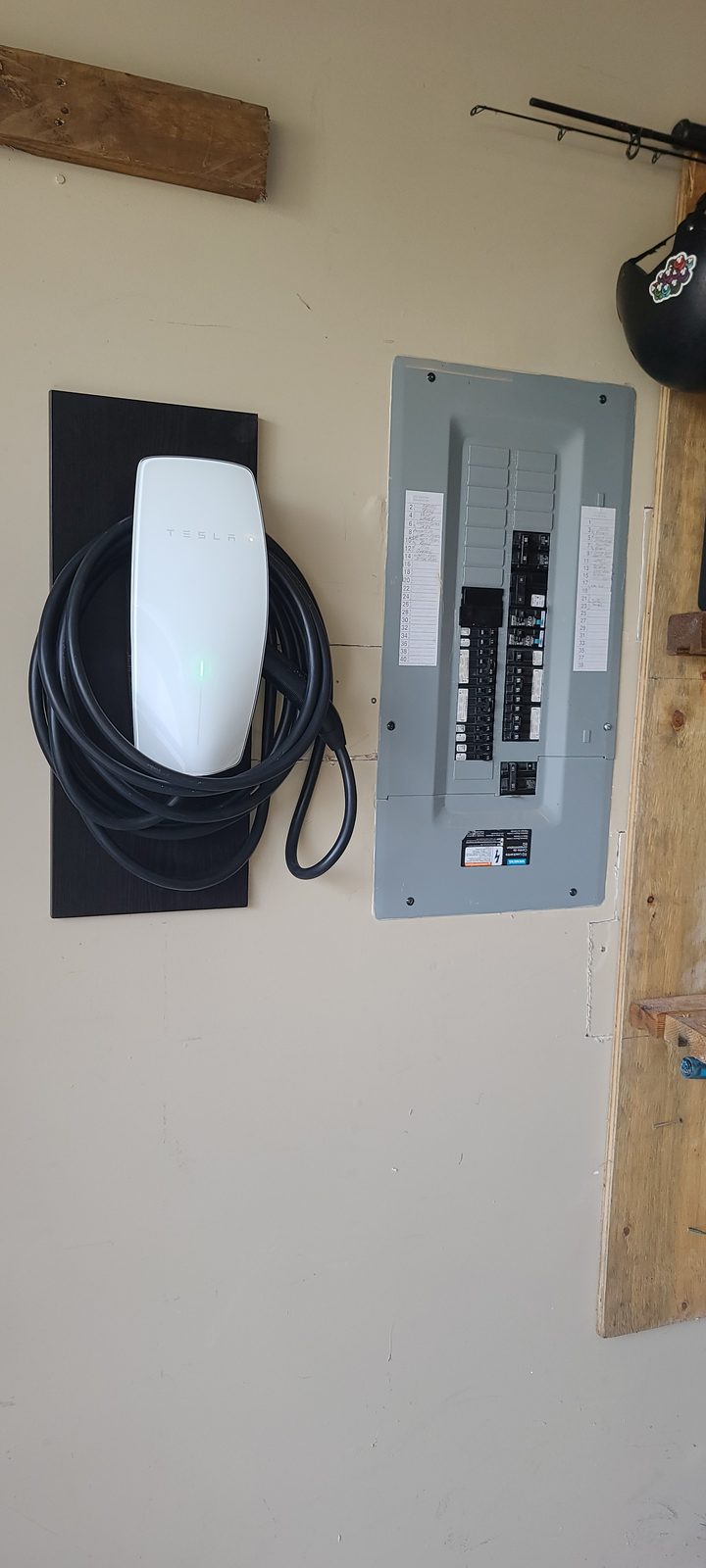
The calculation counts the major loads in your home — electric heat, the range, the dryer, the hot water tank, a heat pump, a hot tub and a secondary suite — because the Canadian Electrical Code asks what the home could draw at once, not what it usually draws on a quiet evening. The electrician also reads the panel itself: main breaker size, spare breaker spaces, equipment age and condition, and how far the panel sits from where you park.
One rule shapes every answer. The Canadian Electrical Code treats EV charging as a continuous load, so the circuit must be rated at 125 percent of the charger’s output: a 32-amp charger goes on a 40-amp circuit, a 40-amp charger on a 50-amp circuit, and a 48-amp charger on a 60-amp circuit. A bigger charger is not automatically better — if your vehicle’s onboard charger tops out at 7.2 kW, a 48-amp unit will not charge it any faster, and it consumes capacity your panel may need for other things.
What a Load Calculation Can Conclude
Most Langley homes land in one of three outcomes:
| Load calculation result | What it means for your home | What happens next |
|---|---|---|
| Enough spare capacity | The panel can carry a Level 2 charger on a new dedicated circuit | The charger is installed on its own 240-volt circuit |
| Tight capacity | The panel is close to its limit when heat, dryer and charger could run together | An approved EV energy management system slows or pauses charging when the house draws heavily |
| Not enough capacity | The home is already near its limit, or a heat pump, hot tub or suite is planned | A panel or service upgrade is the long-term answer |
The middle outcome surprises the most homeowners, and it is often the best news: an EV energy management system is allowed under the electrical code, frequently avoids a service upgrade altogether, and earns an additional BC Hydro rebate for an eligible power management device. Let the calculation — not the charger box — decide the amperage.
The third outcome is not a dead end, but it changes the shape and timing of the project: a panel or service upgrade means a BC Hydro disconnect and reconnect, a permit of its own, and an inspection before the charger circuit is energised. Know this before you buy a charger — a quote that skips the load calculation has not answered the most important question yet.
The Permit Path in Langley: City, Township and Technical Safety BC
Every new EV charger circuit in BC needs an electrical permit, and in Langley the permit comes from Technical Safety BC — Langley is one of the municipalities that does not issue its own electrical permits. Both fall under Technical Safety BC for electrical work, so the permit and inspection run through the provincial regulator whichever side of the Langley boundary your address falls on.
That distinction matters because “Langley” is two separate municipalities with separate building departments, and your property tax notice tells you which one you belong to. The building side — a building permit, if the job needs trenching, a new exterior penetration or a detached garage feed — goes to the City or the Township as applicable. The electrical side goes to Technical Safety BC, and sending the electrical application to the wrong office does not get it forwarded; it starts over.
For work done by a licensed electrical contractor, the contractor normally takes out the permit under its own licence — tying the inspection record to a licensed contractor, which later supports an insurance claim, a rebate application and a sale of the home. A homeowner permit is only an option for your own detached single-family home that you live in; it does not cover a townhouse, condo or strata unit, a rental suite or a home business, and it is not available where a licensed contractor has been hired.
Keep the paperwork: the permit number, charger invoice, itemised installation invoice and a clear photo of the finished installation are what BC Hydro asks for with a rebate application, and the permit number is the proof the work was inspected. A charger installed without a permit leaves you with an installation nobody has checked, a rebate that will be refused, and a problem at sale time when a buyer or insurer asks for the record.
BC Hydro Rebates for Langley Homes (Verified November 2026)
The provincial EV charger rebate program is funded by the Province of BC and administered by BC Hydro (FortisBC customers apply through FortisBC). As of November 2026, the offers for a Langley single-family home are:
- Up to 50 percent of eligible charger purchase and installation costs, to a maximum of $350, for a new, permanently wall-mounted Level 2 charger.
- An additional $200 for an eligible EV power management device installed with the charger (combined total $550).
- A $250 bill credit for enrolling an eligible smart charger in BC Hydro’s Peak Saver program, plus $50 per season enrolled.
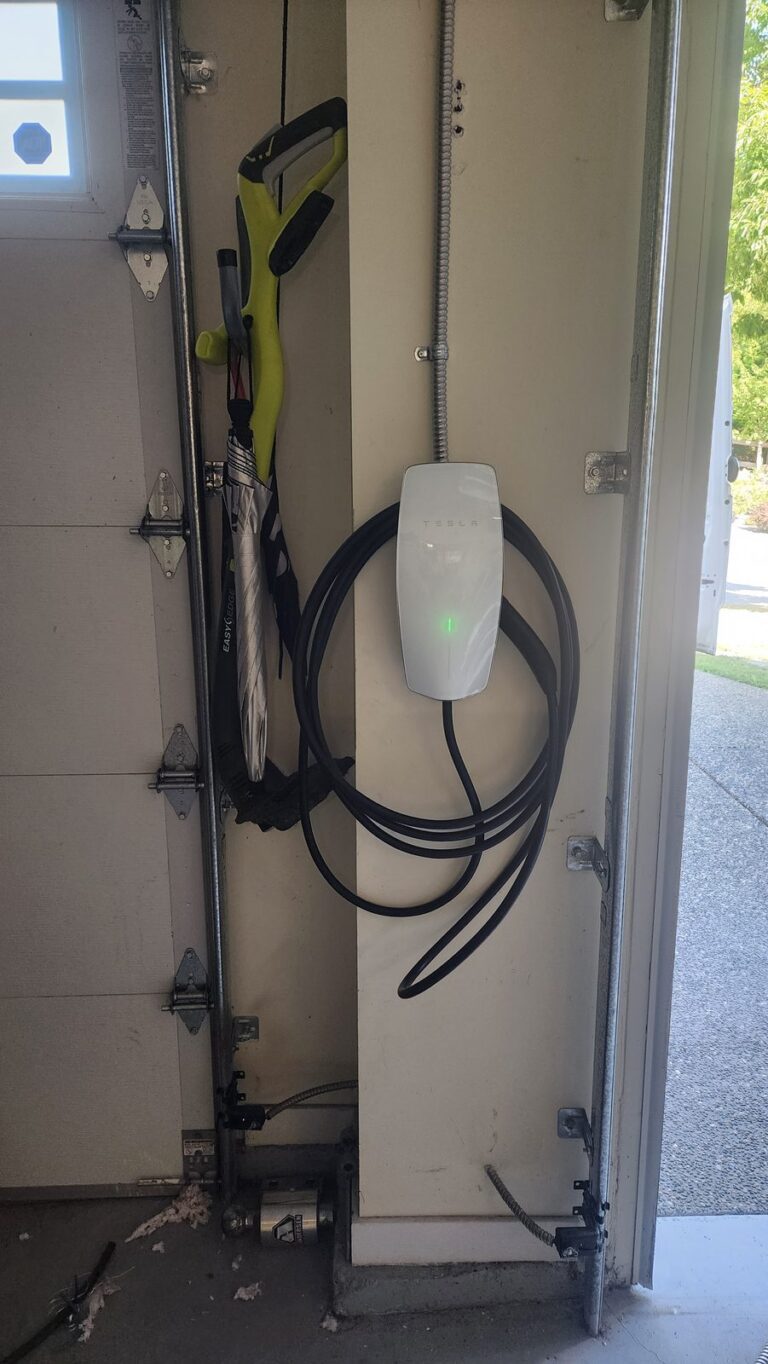
Three details most often cost people the rebate. First, the charger must be on BC Hydro’s eligible list, bought new from a Canadian supplier and permanently wall mounted — a portable cord or an outlet-only installation does not qualify. Second, Tesla-manufactured chargers are not currently eligible, even though a Tesla vehicle can charge from another eligible charger. Third, the application must be submitted within 180 days of the installation or the charger invoice date, whichever came first, and a permit is required.
Langley homeowners should also know what does not apply here: BC Hydro runs additional community top-ups in a small number of specific postal codes — currently Abbotsford and the Mission to Agassiz area — and Langley is not on that list. The standard rebate, the power management top-up and Peak Saver are the offers to plan around; check your postal code on BC Hydro’s site and confirm current terms before buying, because amounts and funding can change.
Strata and workplace installations run on different streams, with higher limits and pre-approval required — check funding before ordering equipment.
The Order of Operations
- Get the load calculation done first, before buying a charger — it decides charger size, circuit size and whether load management or an upgrade is needed.
- Choose the charger from BC Hydro’s eligible list, matched to your vehicle and available capacity.
- Take out the electrical permit with Technical Safety BC, and confirm whether a municipal building permit applies to the cable route or mounting work.
- Install, test and inspect — the inspection closes the permit and creates the record your rebate and insurance rely on.
- Apply for the rebate within 180 days, with the permit number, charger invoice, itemised installation invoice and a photo of the charger installed.
Our general Langley EV charger guide covers charger levels, hardwired versus plug-in units and hiring questions — read it alongside this guide.
Mistakes That Cost Langley Homeowners Time and Money
The most expensive mistake is buying the charger first. A 48-amp charger is no help if the load calculation allows only 32 amps, and a charger that is not on BC Hydro’s eligible list cannot earn a rebate. Confirm capacity and eligibility before buying.
The second is skipping the permit to save time. An unpermitted installation has no inspection record, and BC Hydro requires a permit for eligible new work. The saving is small; redoing the job or losing the rebate is not.
The third is assuming the highest amperage is the right choice. Charging speed is limited by the vehicle as well as the charger, and a larger circuit consumes panel capacity a future heat pump, suite or second EV may need. Size the charger for your real daily driving and leave room for loads you plan to add.
The fourth is forgetting the strata or the municipality. Townhome and condo installations in Willoughby and Walnut Grove need written strata approval and a check of shared building capacity, and a job needing trenching or an exterior run may need a municipal building permit alongside the Technical Safety BC electrical permit — both easier to arrange before the installation date than after it.
Frequently Asked Questions
Do I need an electrical permit for an EV charger in Langley?
Yes. Every new EV charger circuit in BC needs an electrical permit, and in Langley it is issued by Technical Safety BC, not by the City or the Township. A licensed contractor normally takes it out and arranges the closing inspection.
How does a load calculation affect which charger I can install?
It adds up your home’s major electrical loads and compares them with your service size, deciding whether your panel can support a Level 2 charger, at what amperage, or whether load management or a panel upgrade is needed first. The Code treats EV charging as a continuous load, so the circuit must be rated at 125 percent of charger output.
Which BC Hydro rebates apply to a Langley home?
As of November 2026, a single-family home can claim up to 50 percent of eligible costs, to a maximum of $350, plus $200 for an eligible power management device and a $250 Peak Saver bill credit for an enrolled smart charger. Langley is not covered by BC Hydro’s community top-ups, which currently apply to Abbotsford and the Mission to Agassiz area — confirm current terms on BC Hydro’s site before buying.
Can I install an EV charger myself in Langley?
A homeowner permit is only available for your own detached single-family home that you live in; it does not cover townhouses, condos, suites or rentals. Even then, the charger must be installed to code, permitted and inspected, and BC Hydro requires a licensed electrician for rebate eligibility in most cases.
How long does a Langley EV charger installation take?
A straightforward installation is often completed in a single visit once the assessment and permit are done. A long cable route, trenching, panel work, a service upgrade or strata approval can extend the project — confirm the schedule after the site conditions and load calculation are known.
Sources and References
- BC Hydro, home EV charger rebates — rebate, power management top-up, Peak Saver (bchydro.com). Checked 20 Nov 2026.
- BC Hydro, charger rebate top-ups — base amounts by property type and local top-ups (bchydro.com). Checked 20 Nov 2026.
- Technical Safety BC, electrical permits and jurisdiction — Langley permits are issued by Technical Safety BC, not a delegated municipality (technicalsafetybc.ca).
- Township of Langley, building permits — “For gas and electrical permits, refer to Technical Safety BC” (tol.ca).
- CleanBC Go Electric EV Charger Rebate Program — program terms and eligible costs (communityclimatefunding.gov.bc.ca).
- Intel Power Electric, “EV Charger Installation Coquitlam & Tri-Cities” — continuous-load rule and permit process (intelpower.ca/ev-charger-installation/). Checked 20 Nov 2026.
- Intel Power Electric, “EV Charger Installation Langley” and “Electrician Langley” — Langley neighbourhoods and permits (intelpower.ca). Checked 20 Nov 2026.