If you are planning a home or commercial installation in Coquitlam, Port Coquitlam, Port Moody, Burnaby, Pitt Meadows, Maple Ridge, or elsewhere in Greater Vancouver, Intel Power’s EV charger installation team can assess the property, explain your options, manage the electrical work, and help you avoid paying for upgrades you may not need.
EV Charger Installation at a Glance
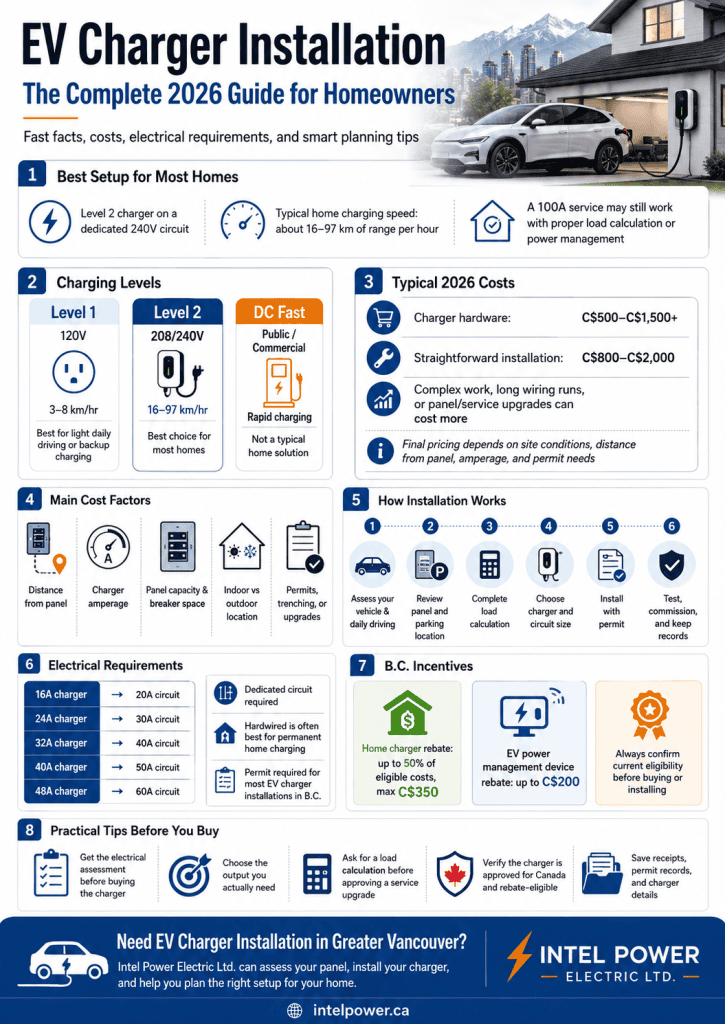
| Question | Practical 2026 Answer |
|---|---|
| Best option for most homes | A permanently installed Level 2 charger on a dedicated 208- or 240-volt circuit |
| Useful home charging output | Usually 3.8 to 11.5 kW, depending on the circuit, charger, and vehicle |
| Typical charging speed | Roughly 16 to 97 km of range per hour for Level 2 charging, depending on the vehicle and charger |
| Typical installation budget | About C$800 to C$2,000 for a straightforward installation, excluding the charger; complex work can cost more |
| Does every home need a 200-amp service? | No. A proper load calculation may show that a 100-amp service can support an appropriately sized charger or an EV power management system |
| Permit required in B.C.? | Yes, an electrical installation permit is required for most EV charger installations |
| Current B.C. home rebate | Up to 50% of eligible purchase and installation costs, to a maximum of C$350, while funding is available |
| Best first step | Have a licensed electrical contractor review the panel, service capacity, parking location, wiring route, and charger specifications before buying equipment |
1. What Is an EV Charger and How Does Installation Work?
The wall-mounted device commonly called an “EV charger” is technically electric vehicle supply equipment, or EVSE. Its job is to deliver electricity safely, communicate the maximum available current to the vehicle, monitor the connection, and stop power flow if it detects a fault. During normal AC charging, the vehicle’s onboard charger converts the incoming alternating current into direct current for the battery.
This distinction matters because the wall unit does not force the car to accept its full advertised output. The vehicle decides how much power it can take based on its onboard charger, battery temperature, state of charge, charging settings, and other conditions. Installing a 48-amp charger will not make a vehicle with a 32-amp onboard charging limit charge at 48 amps.
How charging power is calculated
For a single-phase home installation, charging power is approximately:
Voltage × Current ÷ 1,000 = Charging Power in Kilowatts
| Charger Output | Approximate Power at 240 V | Common Use |
|---|---|---|
| 16 amps | 3.8 kW | Short commutes, plug-in hybrids, or homes with limited capacity |
| 24 amps | 5.8 kW | Moderate daily driving and overnight charging |
| 32 amps | 7.7 kW | A practical choice for many Canadian households |
| 40 amps | 9.6 kW | Longer commutes, larger batteries, or faster overnight recovery |
| 48 amps | 11.5 kW | Vehicles that can accept higher AC charging rates |
Real charging time also includes conversion losses and usually slows near a high state of charge. For example, adding 37.5 kWh to a 75 kWh battery with a 7.7 kW charger may take approximately five to six hours rather than exactly 4.9 hours.
Why daily driving matters more than battery size
You do not usually need to refill an EV from empty every night. A better question is: how much energy must be replaced after a normal day? A driver who travels 50 km per day may use roughly 10 to 15 kWh, depending on the vehicle, weather, speed, hills, cabin heating, and driving style. Even a moderate Level 2 setup can normally replace that energy during an overnight charging window.
This is why a carefully selected 24- or 32-amp charger can be more sensible than automatically installing the highest-output charger available. The right solution meets your real driving needs without creating unnecessary panel, wiring, or service-upgrade costs.
2. Level 1 vs Level 2 vs Level 3 Chargers
Electric vehicle charging is commonly divided into three levels. The most suitable option depends on where the charger will be used, how far the vehicle travels, how long it stays parked, and how much electrical capacity is available.
| Charging Type | Electrical Supply | Typical Output | Approximate Range Added | Best Use |
|---|---|---|---|---|
| Level 1 | 120 V AC | About 1.2 to 1.9 kW | About 3 to 8 km per hour | Low daily mileage, plug-in hybrids, backup charging |
| Level 2 | 208 or 240 V AC | 3.3 to 19.2 kW | About 16 to 97 km per hour | Homes, condos, workplaces, fleets, and destination charging |
| DC Fast Charging, sometimes called Level 3 | High-voltage DC | 20 kW to 350 kW or more | Large amounts of range in a short stop | Public corridors, commercial sites, fleets, and high-turnover locations |
Level 1 charging
Level 1 charging uses a standard 120-volt receptacle and may be enough for drivers with short commutes, plug-in hybrid owners, or vehicles that remain parked for long periods. It is inexpensive when a safe, suitable receptacle already exists, but charging can be too slow for high-mileage drivers or large-battery vehicles.
A garage receptacle should not automatically be assumed suitable for continuous EV charging. Its condition, circuit loading, grounding, protection, and location should be checked. Avoid relying on an extension cord or a receptacle that also supplies freezers, tools, heaters, or other significant loads.
Level 2 charging
Level 2 is the preferred home EV charger installation for most battery-electric vehicles. It uses a dedicated 208- or 240-volt circuit and can be configured at several current levels. The installer can therefore match charging speed to the home’s available electrical capacity rather than treating every project as a maximum-power installation.
DC fast charging
DC fast chargers bypass the vehicle’s onboard AC charger and send direct current to the battery. They require specialized equipment, substantial utility capacity, and considerably more expensive infrastructure. They are not a practical residential solution, but they are important for highway travel, public charging networks, commercial fleets, dealerships, and sites where vehicles must turn around quickly.
3. How Much Does EV Charger Installation Cost?
A straightforward Level 2 EV charger installation in Canada commonly costs about C$800 to C$2,000 for labour, standard materials, and related electrical work, excluding the charger itself. In Greater Vancouver, a longer cable route, outdoor installation, detached garage, difficult wall access, power management device, panel work, or service upgrade can increase the total significantly.
The most reliable way to budget is to separate the charger price from the electrical installation and ask for a written scope. Online “starting prices” often assume the panel is close to the parking space, has enough capacity, has two available breaker positions, and does not require trenching or finished-wall repair.
| Cost Item | Typical 2026 Planning Range in CAD | What Changes the Price? |
|---|---|---|
| Level 2 charger hardware | C$500 to C$1,500+ | Output, cable length, connector, smart features, warranty, networking, and weather rating |
| Straightforward professional installation | C$800 to C$2,000 | Short wiring route, accessible panel, standard mounting, no major upgrades |
| Long or complex circuit route | C$1,500 to C$3,500+ | Finished ceilings, concrete, trenching, detached structures, long conduit runs, or difficult access |
| EV power management solution | Quote-specific | Device type, monitoring method, panel layout, commissioning, and rebate eligibility |
| Panel or service upgrade | Usually several thousand dollars | Existing service, utility coordination, meter equipment, grounding, panel type, permits, and site conditions |
| Permit and inspection | Varies by jurisdiction and scope | Municipal authority, Technical Safety BC jurisdiction, project value, and installation details |
These figures are planning ranges, not fixed quotes. Taxes, drywall repair, trench restoration, utility charges, engineering, and charger hardware may be separate.
The main factors that affect installation cost
- Distance from the electrical panel: Longer runs need more cable, conduit, labour, and sometimes larger conductors.
- Charger output: A 48-amp unit generally needs a larger circuit and conductors than a 24- or 32-amp unit.
- Panel capacity: A load calculation may support the charger, require a lower setting, justify an EV power management system, or show that an upgrade is necessary.
- Panel space: A panel can have enough electrical capacity but no physical breaker positions, or available positions but insufficient capacity. These are different problems.
- Indoor versus outdoor mounting: Outdoor equipment needs the correct enclosure rating, suitable fittings, weather-resistant routing, and physical protection where required.
- Hardwired versus plug-in connection: A receptacle installation adds an outlet, box, cover, and plug connection; hardwiring removes that connection point.
- Parking layout: Detached garages, carports, shared driveways, and assigned condo stalls can require additional planning.
- Permit requirements: The permit must be in place before regulated work begins.
- Future plans: A second EV, heat pump, hot tub, suite, renovation, solar array, or battery system may influence the best design.
How to avoid unnecessary costs
- Get the electrical assessment before purchasing a charger.
- Choose an output that meets your real overnight energy requirement rather than automatically choosing 48 amps.
- Ask for a load calculation before accepting a recommendation for a service upgrade.
- Compare a panel or service upgrade with a code-compliant EV power management option.
- Place the charger close to both the panel and the vehicle’s charge-port location where practical.
- Confirm rebate eligibility before ordering equipment or starting work.
- Plan for the next vehicle, but do not overspend on capacity your current service cannot use.
4. The EV Charger Installation Process Step by Step
Step 1: Define your charging needs
The installer should ask about your vehicle, onboard AC charging limit, average daily distance, parking duration, winter driving, preferred charging schedule, and whether a second EV is likely. This prevents both undersizing and unnecessary oversizing.
Step 2: Review the property and parking location
A site review identifies the electrical panel, service size, large household loads, available breaker space, parking position, wall construction, cable route, outdoor exposure, and potential obstacles such as finished ceilings, concrete, gas equipment, doors, or walkways.
Photos of the panel label, breaker layout, meter, intended charger wall, and route between the panel and parking space can help with an initial estimate. A site visit may still be required before the scope is finalized.
Step 3: Complete a load calculation
The load calculation determines whether the home can safely support the proposed charger. It considers the service rating and existing electrical demand. In B.C., applicable methods may include a code calculation or qualifying historical demand data prepared and documented by the appropriate qualified person.
The outcome may support the requested charger, support a lower current setting, recommend an EV energy management system, or show that a panel or service upgrade is required. A 100-amp label alone does not answer the question.
Step 4: Select the charger, output, and connection type
The charger must be approved for use in Canada, compatible with the vehicle, suitable for the installation environment, and capable of being permanently configured for the circuit. The electrician should also confirm connector type, cable length, mounting height, Wi-Fi availability, and whether load sharing or energy management is required.
Step 5: Confirm the written scope and permit responsibility
A useful quote should state the charger output, breaker rating, wiring route, connection method, permit responsibility, included materials, wall or trench work, commissioning, and any excluded restoration work. In British Columbia, the permit must be obtained before installation begins.
Step 6: Install the dedicated circuit and charger
The electrician installs the breaker, conductors, raceway or cable, disconnecting equipment where required, receptacle or hardwired connection, charger, labels, and any EV power management equipment included in the design.
Step 7: Configure, test, and commission the charger
Adjustable chargers must be set to the permitted circuit output using the manufacturer’s commissioning method. The setting should not be freely changeable by an end user if increasing it could overload the circuit. The installer tests the equipment, confirms communication with the vehicle, checks fault protection, and helps connect the app or network features when included.
Step 8: Close the permit and keep the documentation
Keep the invoice, charger model and serial number, permit documentation, commissioning details, photos, and proof of payment. These records can be important for rebates, warranties, home insurance, future electrical work, and property sales.
Step 9: Apply for available rebates
Application timing and documentation vary by program. Some residential programs allow installation before the final application, while multi-unit and workplace programs may require pre-approval before any purchase or work begins. Always check the current program rules rather than relying on an older blog post or dealer statement.
How long does installation take?
| Project Type | Typical On-Site Work | Possible Delays |
|---|---|---|
| Panel beside an attached garage | Often completed in one visit | Permit processing, charger availability, or panel corrections |
| Long run through a finished home | One full day or more | Access openings, routing decisions, and restoration work |
| Detached garage or outdoor parking | May require multiple stages | Trenching, weather, concrete, underground utilities, and inspections |
| Panel or service upgrade | Longer project with coordination | Utility scheduling, equipment availability, permits, and inspections |
| Condo or strata installation | Installation may be quick after approval | Strata consent, electrical planning, shared infrastructure, billing, and pre-approval requirements |
5. Electrical Requirements: Panel, Wiring and Permits
Dedicated branch circuit
A Level 2 home charger normally requires a dedicated branch circuit. It should not share a general-purpose receptacle circuit with tools, appliances, lighting, or other loads. In multi-unit and managed systems, approved load-sharing designs may serve more than one charger, but they must be engineered or configured as required and installed under the applicable rules.
Breaker sizing and continuous charging load
EV charging is a significant sustained load. A common design principle is that the charger’s continuous output is limited to 80% of the branch-circuit rating. This is why a 40-amp charger is normally associated with a 50-amp circuit and a 48-amp charger with a 60-amp circuit.
| Maximum EVSE Output | Common Minimum Circuit Rating | Approximate Power at 240 V |
|---|---|---|
| 16 A | 20 A | 3.8 kW |
| 24 A | 30 A | 5.8 kW |
| 32 A | 40 A | 7.7 kW |
| 40 A | 50 A | 9.6 kW |
| 48 A | 60 A | 11.5 kW |
| 80 A | 100 A | 19.2 kW |
The final circuit design must follow the charger nameplate, manufacturer instructions, conductor type, installation method, temperature ratings, voltage, local authority requirements, and the current electrical code. This table is an overview, not a substitute for electrical design.
Do you need a panel upgrade or a service upgrade?
A panel upgrade changes the distribution panel and may provide modern equipment or more breaker space. A service upgrade increases the electrical capacity supplied to the property and may involve the meter base, service conductors, utility connection, grounding, and main equipment. Replacing a panel does not automatically increase the service capacity.
You may need further work when:
- The load calculation shows insufficient spare capacity.
- The existing panel is damaged, obsolete, overcrowded, or unsuitable for the new circuit.
- The service equipment cannot accommodate the required breaker or conductors.
- Previous electrical work is unsafe or non-compliant.
- You are adding several large loads, such as an EV charger, heat pump, electric water heater, hot tub, suite, or induction range.
- The utility must increase the available service.
When an upgrade is justified, Intel Power can assess the project and explain the difference between electrical panel and service upgrade options.
Can an EV power management system avoid an upgrade?
Sometimes. An EV energy management system or EV power management device monitors electrical demand and limits or pauses vehicle charging when the home approaches a defined capacity. Charging resumes when capacity becomes available. This can allow practical overnight charging without immediately increasing the service size.
It is not a universal shortcut. The device must be approved for its intended use, compatible with the charger and electrical design, installed correctly, and accepted by the authority having jurisdiction. A load calculation and permit documentation may still be required. B.C. currently offers a separate rebate of up to C$200 for eligible home EV power management devices installed with an eligible Level 2 charger.
Hardwired charger vs NEMA 14-50 receptacle
| Factor | Hardwired Charger | Plug-In Charger |
|---|---|---|
| Connection points | Direct electrical connection with fewer plug-and-receptacle contacts | Uses a receptacle, plug, cord, and charger |
| Maximum common output | Often supports 48 A or more when equipment and circuit allow | Commonly limited to 40 A on a 50 A circuit |
| Outdoor use | Often preferred when installed with suitable weather-rated equipment | Requires a correctly rated receptacle, enclosure, and installation |
| Portability | Removal requires electrical work | Charger can be unplugged and moved, but the destination receptacle must also be suitable |
| Maintenance risk | Fewer mechanical connection points | Receptacle quality, termination, heat, moisture, and repeated movement matter |
| Best fit | Permanent daily home charging | Users who genuinely need portability or already have a verified suitable receptacle |
Technical Safety BC has documented an incident in which an unpermitted EV charging receptacle overheated at a high-resistance connection. The lesson is not that every receptacle installation is unsafe; it is that EV charging places a high sustained load on the connection, so equipment quality, conductor termination, permit history, inspection, and ongoing condition matter.
Electrical permit and inspection in British Columbia
Technical Safety BC states that permits are legally required for EV charger installations in B.C. and that most installations should be completed by a licensed electrical contractor. Some municipalities issue their own electrical permits, while Technical Safety BC handles others. The electrician should confirm the correct authority, obtain the permit before work begins, and complete the required declaration or inspection process.
Unpermitted work can create safety, rebate, insurance, warranty, and resale problems. A lower cash price is not a saving if the project leaves no valid record or cannot pass inspection.
Outdoor charger installation
An outdoor charger should be selected and installed for the actual environment. Review:
- Canadian product approval and the manufacturer’s outdoor-use rating
- Rain, snow, direct sun, salt, drainage, and temperature range
- Cable flexibility in cold weather
- Protection from vehicle impact, snow removal, lawn equipment, and vandalism
- Mounting height and connector storage
- Whether the cable crosses a walkway or can create a tripping hazard
- Wi-Fi or cellular signal if smart functions are required
Bidirectional charging and backup power
Some newer vehicles and charging systems can support vehicle-to-home or vehicle-to-grid operation. This is not the same as installing an ordinary Level 2 charger. It requires a compatible vehicle, approved bidirectional equipment, transfer and isolation controls, utility coordination, and additional electrical design. Do not assume a standard wall charger can power a home during an outage.
6. Rebates and Incentives Available in Canada
EV charger rebates change frequently and funding can close without much notice. The amounts below reflect the current British Columbia program information reviewed in August 2026. Confirm eligibility before purchasing equipment or starting work.
| Program | Current Maximum | Important Conditions |
|---|---|---|
| B.C. single-family home charger rebate | Up to 50% of eligible costs, maximum C$350 | Eligible Level 2 charger; applies to qualifying detached homes, row homes, duplexes, and similar eligible residences |
| Indigenous individual home charger amount | Up to 75% of eligible costs, maximum C$750 | Applicant and project must meet the current program requirements |
| Home EV power management device rebate | Up to C$200 | Eligible device, eligible Level 2 charger, approved electrical permit, and other program conditions |
| BC Hydro Peak Saver smart charging offer | C$250 initial bill credit plus C$50 for each season of continued enrolment | Requires an eligible smart charger and participation in the program |
| EV Ready plan for multi-unit residential buildings | Up to 75% of eligible costs, maximum C$3,000 | Pre-approval is required under the July 2026 program rules |
| EV Ready infrastructure | Up to 50% of eligible costs, maximum C$600 per stall and C$120,000 per building | Qualifying multi-unit building, approved plan, shared infrastructure, and pre-approval |
| EV Ready MURB charger rebate | Up to 50% of eligible costs, maximum C$1,400 per charger and C$14,000 per building | Eligible networked Level 2 chargers and current program requirements |
| Standalone MURB charger rebate | Up to 50% of eligible costs, maximum C$2,000 per charger and C$14,000 per building | Pre-approval, building documentation, and other current eligibility rules |
| Workplace charger rebate | Up to 50% of eligible costs, maximum C$2,000 per charger and C$14,000 per workplace | Pre-approval before work and qualifying workplace charging equipment |
Some municipal, utility, and community top-ups may also be available. Program funding is generally first-come, first-served while funds last, and the total incentive cannot normally exceed the eligible project cost.
What about the rest of Canada?
Canada does not have one universal residential charger rebate that applies equally to every homeowner. Provincial governments, utilities, municipalities, Indigenous programs, and local organizations may offer different incentives. Natural Resources Canada recommends checking with provincial energy providers for available home-installation support. Federal infrastructure programs mainly fund eligible public, fleet, workplace, multi-unit, and commercial charging projects rather than a simple rebate for every private home installation.
Rebate mistakes that cause problems
- Buying a charger that is not on the eligible equipment list
- Starting a condo, apartment, or workplace project before receiving required pre-approval
- Using an installer who does not obtain the required permit
- Missing the application deadline after installation
- Losing invoices, serial numbers, proof of payment, or permit documents
- Assuming every “smart charger” qualifies for every program
- Relying on an outdated rebate article instead of the current program guide
Intel Power can provide installation documentation and support with project coordination. For larger multi-unit or commercial projects that require planning, load management, utility communication, or third-party engineering, review our EV planning and coordination services. Where professional engineering is required, the engineering work is completed by an independent authorized engineering provider in British Columbia.
7. Choosing the Right Charger for Your Home
Start with the vehicle’s maximum AC charging rate
Check the owner’s manual or manufacturer specifications for the vehicle’s maximum AC charging input. Paying for a higher-output installation will not shorten charging time if the vehicle cannot accept the additional power. Also consider whether your next vehicle is likely to have a higher AC limit.
Choose the right connector: J1772 or SAE J3400/NACS
In 2026, the two main connector choices for North American Level 2 charging are SAE J1772 and SAE J3400, commonly called NACS. Many established non-Tesla vehicles use J1772 for AC charging, while Tesla vehicles and a growing number of new models use or are transitioning to J3400/NACS.
Connector decisions should be based on the vehicle you own, the vehicle you expect to buy next, charger availability, and manufacturer-approved adapter support. Do not assume that every adapter supports every vehicle, charging direction, or power level. SAE has also published a dedicated J3400 adapter-safety standard, reinforcing the importance of approved equipment rather than unknown marketplace adapters.
How much amperage do you actually need?
| Daily Driving Pattern | Practical Charger Output to Discuss | Why |
|---|---|---|
| Plug-in hybrid or under 30 km per day | Level 1 or 16 A Level 2 | Long overnight parking usually provides enough recovery |
| 30 to 80 km per day | 16 A to 32 A Level 2 | Balances useful overnight charging with moderate electrical demand |
| 80 to 150 km per day | 32 A to 40 A Level 2 | Provides faster recovery after longer commutes |
| High daily mileage, large battery, limited charging window | 40 A to 48 A Level 2, if supported | More power may be useful when the vehicle and electrical system can use it |
| Two EV household | Load-sharing dual charger or two managed circuits | Shares available capacity intelligently instead of requiring both vehicles to charge at full power at the same time |
These are starting points, not rules. Winter energy use, vehicle efficiency, time-of-use rates, driving schedule, future vehicles, and available service capacity should all be considered.
Smart charger features worth considering
- Scheduled charging: Useful for overnight utility rates and avoiding peak periods.
- Energy tracking: Helpful for estimating charging costs, business reimbursement, or tenant billing.
- Load sharing: Allows two or more compatible chargers to divide available power.
- Demand-response compatibility: May qualify for utility programs such as BC Hydro Peak Saver.
- OCPP support: Important for many commercial, workplace, and multi-unit projects that need network flexibility.
- Local operation: Confirm whether basic charging continues if the internet, app, or cloud service is unavailable.
- Access control: Useful in shared parking, outdoor locations, and workplaces.
- Adjustable output: Valuable when the setting can be securely commissioned to match the installed circuit.
- Warranty and Canadian support: App features are less valuable if replacement parts and technical support are difficult to obtain.
Cable length and charger location
Choose the mounting position after checking the charge-port location on the current vehicle and likely future vehicles. The cable should reach without being stretched, driven over, pinched by a garage door, wrapped tightly around sharp corners, or laid across a regular walkway. Mounting between two parking spaces can be useful for a two-car household if the cable safely reaches both.
Certified and rebate-eligible equipment
Choose a charger with a recognized Canadian certification mark and verify the exact model number. A brand may sell several versions with different connectors, plug types, output ratings, and certifications. Rebate programs often approve specific models rather than every product made by the manufacturer.
Planning for two EVs
Two vehicles do not always require two full-power circuits. Most cars remain parked overnight for many hours and do not both arrive empty. A dual-port charger, compatible power-sharing wall connectors, or an EV energy management system can distribute available power according to demand. The design should also address billing and access when chargers serve different residents or employees.
Condo, apartment, and strata considerations
In a multi-unit building, the first challenge is often approval and shared infrastructure rather than the charger itself. The project may require written strata or landlord consent, an EV Ready plan or electrical planning report, a building load calculation, assigned parking confirmation, a networked charger, usage billing, communications infrastructure, and a plan for future residents.
A one-off charger connected without considering the building’s long-term strategy can create unequal access, capacity conflicts, and expensive rework. For many buildings, it is better to plan infrastructure for all or many stalls and install chargers as residents need them.
A practical buying checklist
- Compatible connector for the current vehicle
- Maximum output supported by the vehicle
- Output that matches the permitted circuit
- Canadian certification mark
- Correct indoor or outdoor rating
- Enough cable length without creating a hazard
- Hardwired or plug-in design chosen intentionally
- Reliable operation without unnecessary cloud dependence
- Smart charging and rebate compatibility
- Load sharing for a future second EV
- Warranty, replacement parts, and Canadian technical support
- Exact model confirmed on the current rebate-eligible list
8. Why Hire a Licensed Electrician for EV Charger Installation?
An EV charger can draw high current for several hours at a time. Small problems that may not be obvious during a short test, such as a loose termination, unsuitable receptacle, incorrect conductor, excessive voltage drop, poor weather sealing, or an overloaded service, can become serious under sustained charging.
A qualified licensed electrical contractor should:
- Verify the charger’s Canadian approval and installation requirements
- Assess the panel, service, grounding, and major existing loads
- Complete or obtain the required load calculation
- Explain whether a lower charger setting, power management device, panel upgrade, or service upgrade is appropriate
- Obtain the correct electrical permit before work begins
- Install the dedicated circuit using suitable conductors, protection, fittings, and labels
- Configure adjustable output so it cannot exceed the installed circuit
- Test and commission the charger
- Close the permit and provide the documentation needed for rebates and records
Questions to ask before accepting a quote
- Is the electrical permit included, and who will obtain it?
- What charger output and circuit rating are included?
- Was a load calculation completed before recommending an upgrade?
- Is the charger hardwired or connected through a receptacle?
- What conductor route and mounting location are included?
- Does the quote include outdoor fittings, trenching, wall repair, or concrete work?
- Is the exact charger model approved in Canada and eligible for the rebate?
- Will the installer commission and permanently limit adjustable output?
- What documentation will I receive when the permit is completed?
- What happens if the panel or existing wiring has an unexpected issue?
Intel Power Electric Ltd. is a full-service electrical contractor serving the Tri-Cities and Greater Vancouver. Our team handles residential and commercial EV charger installations, panel and service work, electrical planning support, permit coordination, and load-management solutions. Request an EV charger installation assessment before purchasing equipment so the charger, circuit, and property are planned as one system.
9. Frequently Asked Questions About EV Charger Installation
The following questions reflect recurring concerns raised by Canadian EV owners in communities such as r/EVCanada, r/evcharging, Tesla owner forums, condo discussions, and local homeowner groups. The answers are based on current Canadian and B.C. electrical-safety guidance rather than informal forum advice.
Do I need a 200-amp panel to install a Level 2 EV charger?
No. Many homes with 100-amp service can support Level 2 charging after a proper load calculation, especially at 16, 24, or 32 amps. An EV power management system may also allow charging without a service upgrade. A 200-amp service may be recommended when the home already has high electrical demand, the existing equipment is unsuitable, or several future loads are planned.
Can I install a 48-amp charger on a 50-amp breaker?
No. A 48-amp continuous charging output is normally associated with a 60-amp circuit. A 50-amp circuit commonly supports up to 40 amps of continuous EV charging. The exact design must follow the charger nameplate, manufacturer instructions, electrical code, conductor type, and local authority requirements.
Is hardwiring safer than using a NEMA 14-50 outlet?
Hardwiring removes the plug-and-receptacle connection and is often preferred for a permanent daily charger, high output, or outdoor location. A properly installed plug-in charger can also be safe when the receptacle, enclosure, breaker, conductors, terminations, and equipment are suitable for sustained EV charging. Existing dryer or range outlets should not be assumed suitable without inspection.
Can I use my dryer outlet for EV charging?
Do not connect a vehicle charger to a dryer circuit without a licensed electrician reviewing the complete setup. The circuit may have the wrong receptacle, conductor configuration, breaker size, location, or loading. Manual unplugging and frequent swapping can also wear the receptacle. Approved energy-management or circuit-sharing solutions exist for some situations, but they must be selected and installed correctly.
Can I use an extension cord with my EV charger?
Avoid using an extension cord unless the vehicle or charger manufacturer explicitly permits a specific approved product and the installation meets local requirements. Ordinary household extension cords can overheat, create voltage drop, expose connections to moisture, and create trip or damage risks. The safer solution is a correctly located permanent receptacle or charger.
Will a 32-amp charger be fast enough?
For many households, yes. At 240 volts, a 32-amp charger provides about 7.7 kW. That can replace a substantial amount of daily driving during an overnight session. A higher-output charger is most useful for long daily mileage, large batteries, short parking windows, or a vehicle that can accept the additional AC power.
Does a larger charger always charge the car faster?
No. Charging is limited by the lowest-capacity part of the system: the circuit, EVSE setting, vehicle’s onboard AC charger, battery conditions, and charging software. A vehicle limited to 7.2 or 7.7 kW will not charge faster from an 11.5 kW wall unit.
Should I install load management instead of upgrading the panel?
Load management can be a cost-effective option when the existing service has limited spare capacity but remains otherwise safe and suitable. It pauses or reduces charging during periods of high household demand. A service upgrade may be the better long-term choice when the panel is obsolete, damaged, overcrowded, or when the home will add several large electrical loads. Compare both options after a documented assessment.
Can the charger be installed outside in rain and snow?
Yes, when the charger and all related equipment are approved for outdoor use and installed correctly. The design should address enclosure rating, drainage, direct weather exposure, cold-weather cable flexibility, connector storage, physical protection, and safe cable routing. An indoor-rated charger should not be placed outdoors under the assumption that a roof overhang is enough.
Do I need Wi-Fi for a home EV charger?
No for basic charging, provided the charger is designed to operate locally. Wi-Fi can add scheduling, energy tracking, utility-program participation, remote access, alerts, and load-sharing features. Before buying, confirm whether the charger continues normal charging during an internet outage and whether important features require an ongoing subscription or cloud service.
Should I choose J1772 or NACS/J3400 in 2026?
Choose the connector that directly fits your current vehicle unless you have a clear future-vehicle plan and an approved adapter strategy. J1772 remains widely used for Level 2 AC charging, while J3400/NACS adoption is expanding across North America. A replaceable cable, dual-connector charger, or manufacturer-approved adapter may provide flexibility, but compatibility should be confirmed for the exact vehicle and charger.
Can I install a charger before my EV is delivered?
Yes, and doing so can be convenient. Confirm the exact vehicle connector, maximum AC charging rate, parking orientation, charge-port position, and any manufacturer charger requirements before finalizing the installation. Test the charger when the vehicle arrives and keep the permit and commissioning records.
Can two EVs share one circuit?
Yes, with approved equipment designed for load sharing or energy management. Two compatible wall connectors may divide a fixed amount of available current, or a dual-port unit may charge both vehicles according to programmed rules. Do not use an improvised splitter or unapproved adapter.
Why does my charger, plug, or outlet feel warm?
Some warmth can occur during high-power charging, but a hot plug, discolouration, melting, repeated fault messages, buzzing, burning smell, or charger shutdown requires immediate attention. Stop charging safely and contact a licensed electrical contractor. Do not continue using a damaged receptacle or reduce the charging current as a substitute for repairing the cause.
Will an EV charger increase my electricity bill a lot?
Your bill increases by the energy delivered to the vehicle, not simply because a charger is installed. Estimate monthly charging energy by multiplying daily driving by the vehicle’s average kWh per 100 km, then multiply by the electricity rate. Charging losses and winter consumption should be included. Smart scheduling can help move charging to lower-priced periods where time-of-day rates are available.
Is overnight charging safe?
Yes, when the charger and circuit are properly designed, permitted, installed, and maintained. EVs and approved EVSE include monitoring and fault protection. Do not use damaged cables, uncertified equipment, improvised adapters, extension cords, or unverified receptacles for routine overnight charging.
Do condo owners need strata approval?
Usually yes. In B.C., alterations affecting common property, shared electrical systems, or assigned parking normally require written strata or building approval. The project may also need an EV Ready plan, electrical planning report, load calculation, networked charger, billing arrangement, and pre-approval for rebates. Start with the strata council or property manager before buying a charger.
Can a renter install an EV charger?
A renter needs the property owner’s written permission and may also need strata or building approval. The agreement should address installation cost, ownership of the charger and circuit, electricity billing, maintenance, removal, insurance, and what remains when the tenancy ends.
How often does a home EV charger need maintenance?
Home chargers are generally low-maintenance, but owners should regularly inspect the cable, connector, enclosure, plug or hardwired connection area, and mounting. Keep the connector clean and stored properly. Arrange professional service if you notice heat damage, loose equipment, corrosion, water entry, repeated breaker trips, fault codes, or physical damage.
Do I need surge protection?
A charger contains protective electronics, but whole-home surge protection may provide additional protection for the charger and other appliances. It does not replace correct grounding, bonding, circuit protection, or manufacturer-required devices. Ask the electrician whether surge protection makes sense for the property and local utility conditions.
Can a regular Level 2 charger power my home during an outage?
No. Vehicle-to-home backup requires a compatible bidirectional vehicle and charger, approved transfer and isolation equipment, utility coordination, and a specifically designed electrical system. A normal one-way Level 2 charger cannot safely backfeed a home.
Final EV Charger Installation Checklist
- Confirm the vehicle’s connector and maximum AC charging rate.
- Estimate daily energy needs instead of focusing only on a full battery recharge.
- Have the panel, service, and parking location assessed before buying the charger.
- Request a documented load calculation before approving a service upgrade.
- Compare lower-current charging, load management, panel work, and service-upgrade options.
- Choose approved equipment suitable for Canadian use and the installation environment.
- Confirm the exact model is eligible for any rebate you plan to claim.
- Decide between hardwired and plug-in installation based on daily use, output, location, and portability.
- Make sure the electrical permit is obtained before work begins.
- Keep invoices, permit records, model and serial numbers, photos, and commissioning documents.
- Schedule charging for overnight or off-peak periods when appropriate.
- Plan for a second EV or future home electrification without automatically oversizing the current installation.
A good EV charger installation is not the installation with the largest breaker or the most expensive wall unit. It is the installation that safely meets your driving needs, fits the property, complies with the permit and electrical requirements, qualifies for available incentives, and remains useful as your household changes.
For a clear assessment and written installation plan in the Tri-Cities or Greater Vancouver, contact Intel Power Electric Ltd. Our team can review your panel, calculate the required capacity, install the charger, coordinate permits, and explain practical alternatives when a standard installation is not the best fit.
Editorial note: Electrical requirements vary by jurisdiction, installation method, equipment, and property. Rebate amounts and program rules can change. This article provides general information and does not replace a site-specific assessment, permit review, electrical design, manufacturer instructions, or advice from the authority having jurisdiction.