You’ve brought home a new electric vehicle, and now you want to know how soon you can start charging in your own driveway or garage. For most homes in Coquitlam, Port Coquitlam, Port Moody and Burnaby, the actual EV charger installation takes just a few hours. The full timeline, though, depends on your electrical panel, where you park, and which office issues your permit.
Here’s what a realistic home EV charger installation timeline looks like, what can slow it down, and how to get charging sooner.
Typical Installation Timeline
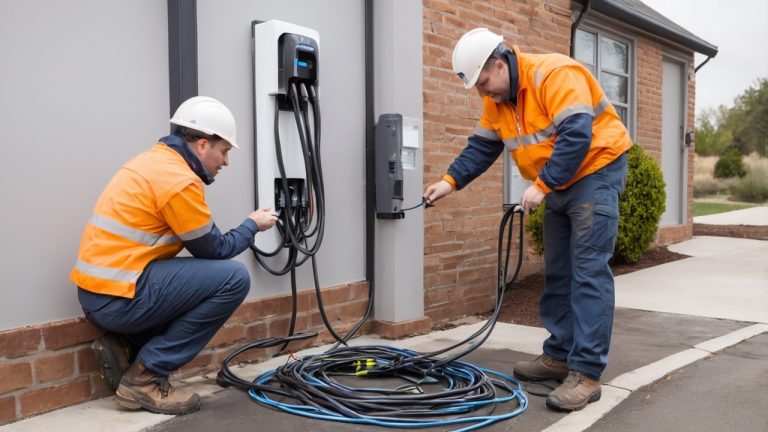
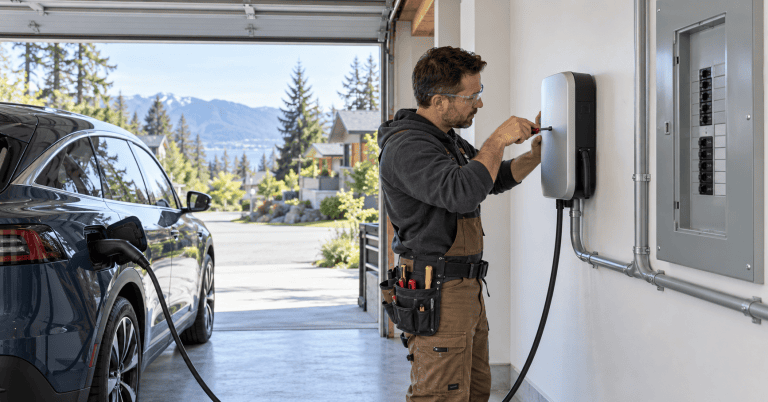
For a straightforward Level 2 charger installation, the on-site work usually takes about 2 to 4 hours. In that time, the electrician runs a dedicated 240 volt circuit from your panel, installs the breaker, mounts the charger, and tests it with your vehicle.
From your first call to your first charge, the process usually follows these steps:
- Photos and site visit: we review your panel, parking spot and cable route
- Load calculation and written quote: we confirm how much capacity your home has left
- Electrical permit: filed with Technical Safety BC or your city, depending on your address
- Installation day: a single visit for most homes
- Inspection and handover: the work is inspected and you get your permit number and invoice
For a simple job, many homeowners in the Tri-Cities are charging within one to two weeks of booking. The EV charger installation time grows when the job needs extra electrical work, strata approval or utility coordination.
You can see each stage in more detail in how our EV charger installation process works from quote to inspection.
Simple vs Complex Installs
A simple install is one where your panel has spare capacity, sits in or near the garage, and the cable run to your parking spot is short. Many newer homes on Burke Mountain, Westwood Plateau and in the Dominion Triangle fit this description, since they often have 200 amp service and an attached garage. These jobs are usually finished in one visit.
A complex install needs work beyond a new circuit and a wall-mounted charger. Common examples include:
- Older homes on 100 amp service that need a load management device or a panel upgrade
- Hillside homes in Port Moody where the panel is on a different level from the parking
- Carports and driveways that need an outdoor rated charger and exterior conduit
- Detached garages that need trenching
- Condo and townhouse installs that depend on shared building capacity
These projects can take one to three days on site. When a panel or service upgrade is part of the job, the overall timeline is longer because the power has to be disconnected and reconnected by BC Hydro.
A 100 amp panel doesn’t automatically mean you need an upgrade, so start with how to check if your electrical panel can handle an EV charger.
What Can Delay Your Installation
Panel capacity is the most common reason an EV charger installation takes longer than expected. Many older homes in Maillardville, Austin Heights, Capitol Hill and Burnaby Heights still run on their original 100 amp service. If the load calculation shows there’s little room left, the solution might be an EV energy management system or a full upgrade, and either one adds planning time.
Utility scheduling is another factor. Any work that requires BC Hydro to cut and restore power depends on their availability, which you can’t speed up once the request is in.
Strata approval is often the longest wait for condo and townhouse owners. Since 2023, many EV charging decisions only need a majority vote, but councils still need technical details about the charger, the wiring route and the building’s electrical capacity before they approve the work.
If you live in a strata, read more about EV charger installation for condos, townhomes and strata buildings.
Other common delays include a charger model on backorder, older wiring that has to be corrected first, and wet weather slowing down trenching or outdoor conduit work.
Permit and Inspection Wait Times
Every new EV charger circuit in BC needs an electrical permit. In Coquitlam, Port Coquitlam, Port Moody, New Westminster and Pitt Meadows, permits go through Technical Safety BC. Burnaby, Maple Ridge, Surrey, North Vancouver and West Vancouver issue their own electrical permits and do their own inspections.
That difference affects your timeline. Permit processing and inspection scheduling depend on the authority and how busy it is, so wait times can range from a few days to a couple of weeks.
For a city-by-city breakdown, see who issues EV charger permits in Burnaby and the Tri-Cities.
You can also confirm the right office for your address using the Technical Safety BC electrical permit jurisdiction lookup.
A licensed electrical contractor files the permit and arranges the inspection for you. Skipping the permit isn’t worth the time it seems to save, since it can leave you with uninspected work and a BC Hydro rebate application that gets refused.
How to Speed Up the Process
A few simple steps can shorten your EV charger installation timeline:
- Send clear photos of your electrical panel and parking spot when you first reach out
- Check your vehicle’s onboard charging rate so the right charger size is chosen from the start
- If you plan to apply for a BC Hydro rebate, pick a charger from the eligible list before installation day
- Submit your strata request as early as possible if you live in a condo or townhouse
- Clear the garage or install area so the crew can start right away
- Hire a licensed electrician who handles the permit, inspection and rebate paperwork
Planning ahead also helps with your budget, so take a look at our guide to EV charger installation cost in Metro Vancouver for 2026.
Ready to start charging at home? Intel Power Electric has been serving the Tri-Cities and Burnaby since 2005. Call us at (604) 618-0977 or send photos of your panel and parking spot, and we’ll tell you what your home can support and how long your installation will take before any work begins.