Electrical problems usually announce themselves quietly: a flicker, a warm outlet, a breaker that trips twice. A burning smell is the announcement you never ignore. Burning plastic, melting insulation and overheating connections all smell before they flame — that smell is your early-warning system, and it is buying you time to act. Here is what to do in the first minutes, what the smell usually means, and how an electrician tracks it down.
The first five minutes: do this, in this order
- Stop and locate roughly where the smell is strongest — a room, an outlet, a switch, or the electrical panel. Do not put your face close to a panel or outlet to sniff it out.
- If you see smoke, flames or active burning: get everyone out and call 911. Electrical fires are not a DIY moment.
- Turn off the power to the affected circuit at the breaker panel. If you cannot tell which circuit it is, or the smell is coming FROM the panel itself, switch off the main breaker.
- Do not use water on anything electrical. If a small flame is present and you have a fire extinguisher rated for electrical fires (Class C / ABC), you may use it from a safe distance — otherwise, leave it to the fire department.
- Leave the power off and call an emergency electrician in the Tri-Cities. A burning smell that “went away on its own” has not fixed itself; it has usually just stopped because the circuit went dead or the material finished melting.
Do not reset the breaker “to see if it still smells.” Re-energising a fault that has already heated up once is how a smoulder becomes a fire.
What the smell is telling you
| Smell | Likely source | Urgency |
|---|---|---|
| Burning plastic / acrid chemical | Melting insulation or an overheating outlet/device | Power off now; electrician today |
| Fishy or urine-like odour | Overheating plastic/resin in outlets, switches or fixtures — a classic early sign | Power off the circuit; electrician today |
| Burning rubber | Overheated wiring insulation or appliance motor | Power off; electrician today |
| Smell only when a specific appliance runs | The appliance itself (motor, element, cord) | Unplug it; do not use it until checked |
| Smell at the panel with buzzing | Loose or failing breaker/panel connection | Main breaker off; emergency call |
| Smell after a new bulb or fixture install | Wrong wattage, or a fixture fault | Switch off that light; have it checked |
Loose connections are the number-one cause. A wire that is not tight on its terminal — or an outlet whose contacts have worn loose — creates resistance, and resistance creates heat every time current flows. The plastic of the outlet and the insulation of the wire slowly cook. This is also why a burning smell often arrives together with an outlet that sparks when you plug something in: both are symptoms of connections that no longer make clean contact.
Overloaded circuits run hot along their whole length. A circuit asked to carry a space heater, a kettle and a microwave on wiring sized for less will heat its weakest point first — usually a connection.
Older wiring systems deserve special mention. Many Coquitlam and Port Coquitlam homes built in the late 1960s and 1970s still have aluminium wiring in older Tri-Cities homes, whose connections loosen and oxidise over time and are a well-documented overheating risk when they have not been properly remediated.
Failing breakers and panels can cook from the inside: a breaker that no longer seats firmly on the panel bus, or a panel with a history of moisture, can arc and overheat behind a closed door. A panel that smells, buzzes or feels warm is an emergency, full stop.
What NOT to do
- Do not keep using the outlet, switch or appliance “because the smell faded”
- Do not spray anything into an outlet or panel
- Do not open the panel’s inner cover — conductors inside remain live even with breakers off
- Do not assume a fishy smell is plumbing or pests until the electrical possibility is ruled out — electricians across BC get this call every week, and it is electrical often enough that it has a nickname in the trade
How an electrician finds the source
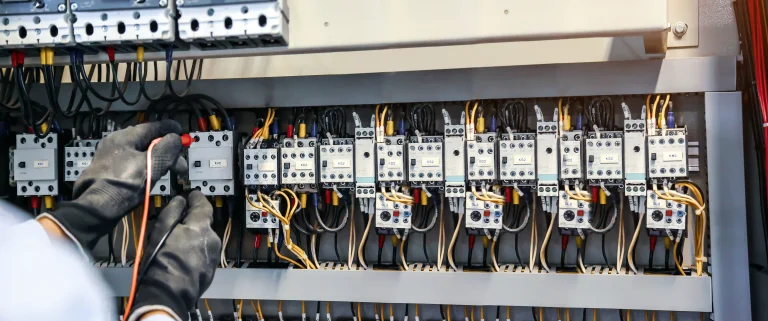
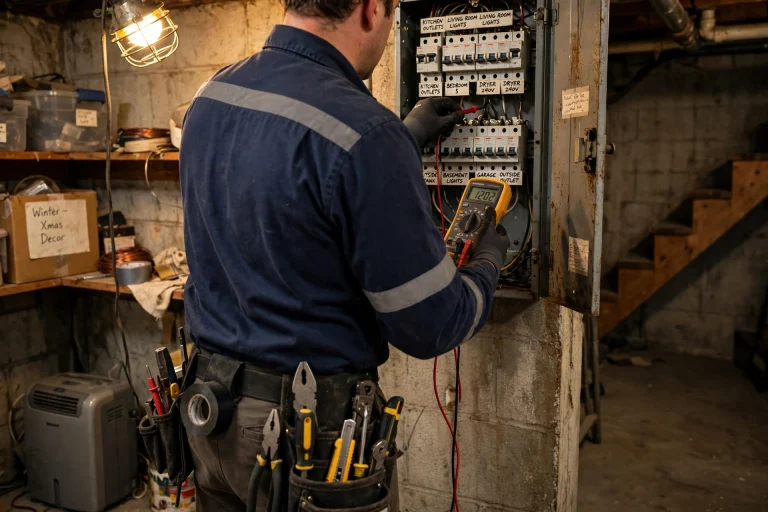
With the circuit safely off, an electrician works from the smell outward: inspecting the outlet or device, checking connections for heat damage and discolouration, testing the circuit’s load, and examining the breaker and panel connection. Thermal imaging can reveal a connection that runs hot under load before it fails completely. The repair ranges from replacing a cooked receptacle and re-terminating its wires properly, to replacing a damaged breaker, to remediating aluminium connections — and the finding, not the guess, decides which.
Intel Power Electric handles electrical emergencies across Coquitlam, Port Coquitlam, Port Moody, Vancouver and Burnaby. If something in your home smells like burning plastic or fish and you cannot name the source, treat it as electrical until proven otherwise.
Frequently asked questions
Why does overheating electrical smell like fish?
Certain plastics and resins used in outlets, switches and fixtures release a fishy or urine-like odour when they overheat. It is one of the most reliable early warnings of an electrical fault in a home.
The smell stopped. Is it safe to turn the breaker back on?
No. The smell usually stops because the circuit stopped carrying current or the damaged material cooled. The fault is still there. Keep the breaker off until an electrician has inspected the circuit.
Can a burning smell come from a light fixture?
Yes — an overheating ballast, a bulb above the fixture’s rated wattage, or a loose connection in the fixture box can all produce it. Switch the light off at the wall and have it checked.
Is a burning smell from the panel always an emergency?
Yes. Heat, smell, buzzing or discolouration at the panel means a fault in the heart of the home’s electrical system. Turn off the main breaker and call an electrician; call 911 if there is smoke or flame.
What if I can’t find where the smell is coming from?
Turn off breakers one at a time and note when the smell stops growing — that narrows the circuit. Then leave that breaker off and call an electrician with the information; it genuinely helps the diagnosis.
Sources
- Technical Safety BC — electrical safety guidance: https://www.technicalsafetybc.ca
- Electrical Safety Foundation International — home electrical fire prevention: https://www.esfi.org
- National Fire Protection Association — electrical fire safety resources: https://www.nfpa.org