Flickering lights sit on a spectrum. At one end: a dying LED bulb that costs four dollars to replace. At the other: a failing connection in your electrical service that is quietly damaging every appliance in the house. The trick is knowing which pattern you are looking at. Start with the pattern, then match it to the cause.

First, read the pattern
| Pattern | Most likely causes | Urgency |
|---|---|---|
| One bulb, one fixture | Loose or dying bulb; failing fixture | Low — check the bulb first |
| One room flickers | Circuit connection, dimmer, or fixture issue | Book an electrician |
| Whole house flickers when a big appliance starts | Service capacity or a loose service connection | Electrician soon |
| Whole house flickers randomly, appliances behaving oddly | Loose neutral / failing service equipment | Urgent |
| Flicker with buzzing or a burning smell | Arcing connection | Emergency — power off, call now |
| Flicker only in stormy/windy weather | Utility-side or service-drop issue | Report; electrician if it persists indoors |
The 8 causes, from simplest to most serious
1. A loose or dying bulb. The most common cause by far. A bulb that is not screwed in fully, or an LED at the end of its life, flickers alone while everything around it stays steady. Tighten it; swap in a known-good bulb; if the flicker follows the bulb, you have your answer.
2. An incompatible dimmer. LEDs and older dimmers frequently disagree. The result is flicker or buzz at certain brightness levels, in one room, on lights that are otherwise fine. The fix is a dimmer rated for the bulbs it controls — a small job that ends a daily annoyance.
3. A failing fixture or switch. A light fitting or wall switch with worn contacts can flicker when touched, vibrate, or behave only in certain positions. If one fixture flickers and its bulb is proven good, the fixture or its switch is next on the list.
4. An overloaded circuit. Lights dimming or flickering when the kettle, microwave or space heater starts on the same circuit means the circuit is straining. Voltage dips under load, and lights show it first. This is the same family of problems as a breaker that keeps tripping — the circuit is telling you its limit.
5. A loose connection somewhere in the circuit. A wire nut that was never quite tight, a backstabbed outlet connection working loose, a terminal screw a quarter-turn short — loose connections flicker intermittently, often when a door slams or the furnace vibrates. They also generate heat, which is why this cause graduates from nuisance to hazard if ignored.
6. Voltage fluctuations from the utility. If the whole street’s lights flicker in a storm, that is BC Hydro’s side of the meter. If only your house flickers while your neighbours’ lights stay steady, the problem is between the street and your panel — your side to repair.
7. A loose or failing neutral connection. The most important cause on this list. The neutral conductor keeps the two halves of your 240-volt service balanced. When it loosens or fails, voltages swing: some lights get brighter, others dimmer, and electronics and motors can be damaged or destroyed. Random whole-house flicker with lights that brighten as well as dim is the textbook signature. Treat it as urgent.
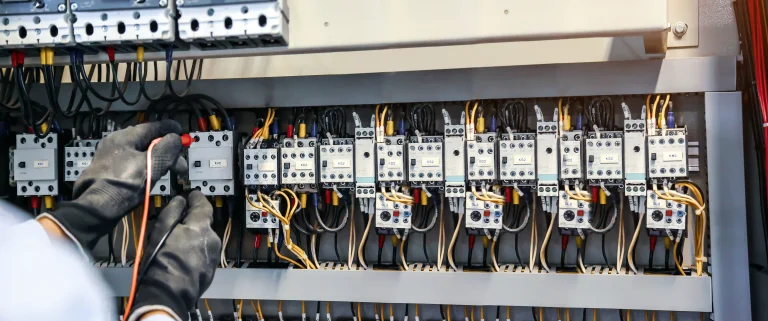
8. A failing panel or service equipment. An ageing main breaker, corroded bus connections, or a damaged meter base can make the whole home’s power unstable. Add buzzing, warmth or a smell at the panel and it stops being a “book it this month” problem — it becomes a same-day call to an emergency electrician in the Tri-Cities.
A five-minute check you can do safely
- Note the pattern from the table above: one bulb, one room, or the whole house?
- Swap the flickering bulb with a bulb from a steady fixture. Does the flicker move?
- Watch what else is running when it flickers — a cycling appliance (fridge, dryer, hot tub) is a strong clue.
- Check whether neighbours see it too, if you can do so easily.
- Look — without touching — at the panel: any buzzing, warmth or smell means stop here and call an electrician.
Do not open the panel’s inner cover or tighten anything inside it yourself; the conductors there stay live even with the main breaker off.
When flickering means “call today”
- Whole-house flicker, especially with lights brightening as well as dimming
- Flicker plus buzzing, sizzling, warmth or a burning smell anywhere
- Flicker that began after a storm, a outage, or work on the home
- Appliances resetting, behaving strangely or failing alongside the flicker
For everything short of that — a room that flickers, a dimmer that argues with its bulbs, a fixture on its last legs — our lighting installation and repair services cover diagnosis through replacement across Coquitlam, Port Coquitlam, Port Moody, Vancouver and Burnaby. Intel Power Electric will tell you honestly when the fix is a four-dollar bulb.
Frequently asked questions
Why do my lights flicker when the washing machine or dryer runs?
Large motors draw a surge of current when they start, which briefly dips the voltage on the circuit — lights show the dip. Mild dimming at startup is common; strong flicker suggests the circuit is overloaded or a connection is loose.
Can flickering lights damage my electronics?
Brief, minor dips rarely do. The voltage swings from a failing neutral or service connection absolutely can — they can push well above normal voltage into some circuits. That pattern is the urgent one.
Why do my LED lights flicker but the old bulbs didn’t?
LEDs react instantly to voltage changes that incandescent bulbs smoothed out, and many older dimmers were never designed for them. The flicker is often a compatibility issue, solved with the right dimmer or driver.
Is whole-house flickering an emergency?
It can be. Whole-house flicker with brightening, buzzing or smells should be treated as urgent. Whole-house flicker only during storms is usually the utility’s side — report it to BC Hydro and watch whether it continues in calm weather.
What will an electrician actually check?
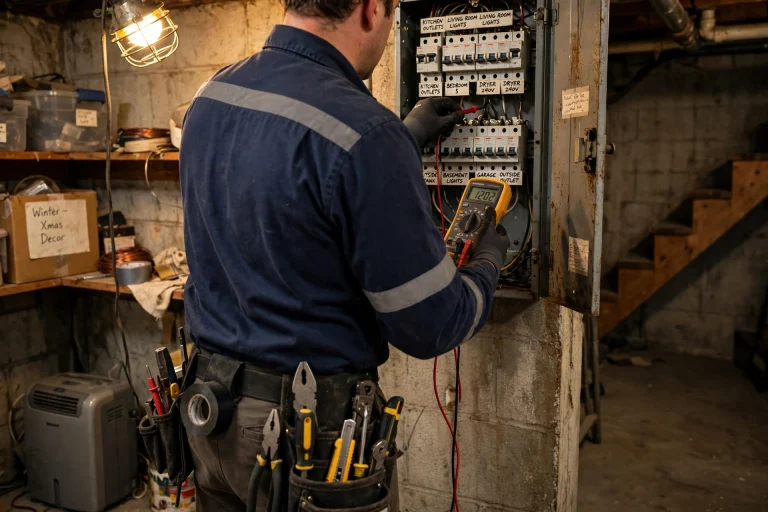
Connections at the fixture, switch and circuit devices; the load on the circuit; breaker and bus connections at the panel; and, where the pattern points to it, the service neutral and meter base — measuring voltage under load to catch swings a glance would miss.
Sources
- BC Hydro — power quality and outage information: https://www.bchydro.com
- Technical Safety BC — electrical safety guidance: https://www.technicalsafetybc.ca
- Electrical Safety Foundation International — home electrical safety resources: https://www.esfi.org