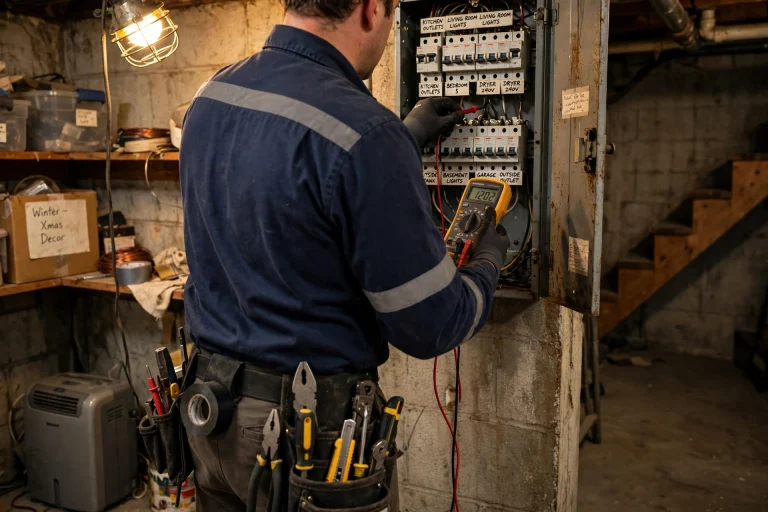
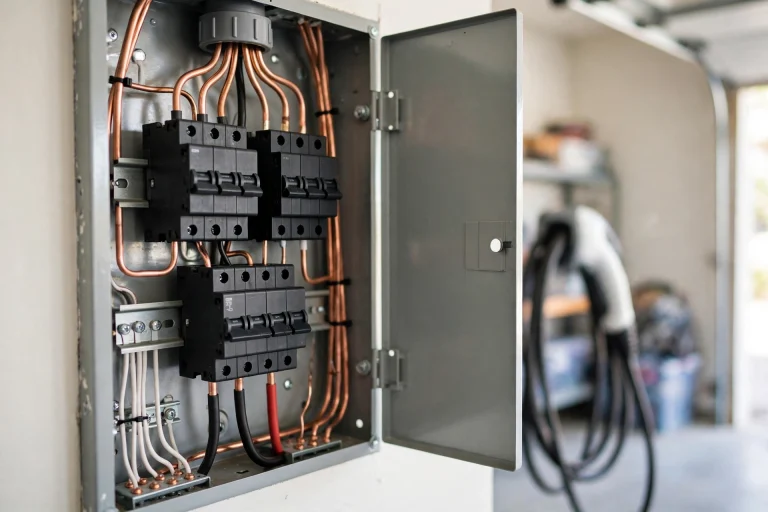
A circuit breaker has one job: to cut power before a wire overheats. When it trips, it is not malfunctioning — it is reporting. Resetting it once after you unplug a kettle and a space heater that were sharing a circuit is reasonable. Resetting the same breaker every day, or finding it tripped with nothing obviously running, means the report needs reading. These are the seven causes our electricians find most often in Coquitlam, Port Coquitlam and Port Moody homes, in roughly the order we check them.
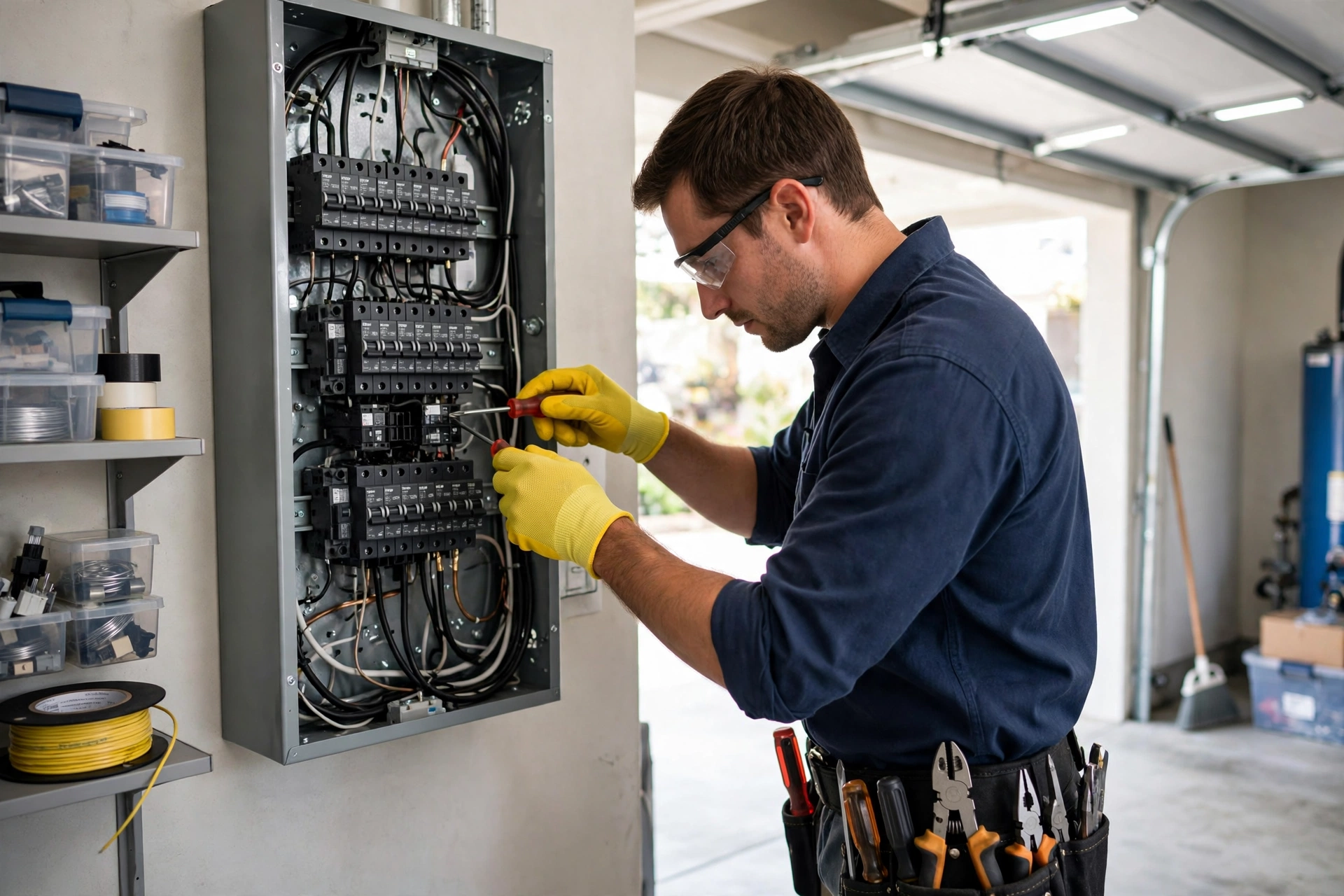
The 7 causes of a breaker that keeps tripping
| # | Cause | The clue | Safe first check |
|---|---|---|---|
| 1 | Overloaded circuit | Trips when several appliances run together | Move one load to another circuit |
| 2 | Short circuit | Trips instantly, sometimes with a pop or smell | Unplug everything on the circuit, then call an electrician |
| 3 | Ground fault | Trips near water — bathroom, kitchen, outdoors | Press the GFCI test/reset; if it re-trips, call an electrician |
| 4 | Arc fault | AFCI breaker trips with no obvious overload | Note which devices were running; call an electrician |
| 5 | A failing appliance | Trips only when one specific device runs | Stop using that device until it is checked |
| 6 | A worn-out breaker | Trips under light load, or feels loose/warm | Electrician testing required |
| 7 | An undersized panel | Trips across several circuits as the home’s load grows | Time to discuss a panel upgrade |
1. Overloaded circuit. The classic: a 15-amp kitchen or living-room circuit carrying a microwave, kettle and toaster oven at once. Homes were wired for the loads of their era; a 1970s Port Coquitlam kitchen circuit was not designed for an air fryer, an espresso machine and a kettle simultaneously. The fix ranges from redistributing loads to adding a dedicated circuit.
2. Short circuit. A hot wire touching a neutral or ground wire — through damaged insulation, a nail through a cable, or a failed appliance — creates a massive, instant current surge. The breaker trips immediately, sometimes with a bang or a burning smell. Do not keep resetting it: each reset slams the fault with full current again.
3. Ground fault. Current leaking to ground, often where water is present. GFCI breakers and outlets are deliberately sensitive — they trip in a fraction of a second to protect people, not wiring. A GFCI that will not hold a reset usually means the fault is real, not that the device is “too sensitive.”
4. Arc fault. Damaged or deteriorating wiring can arc — small, hot, intermittent sparks along a wire or at a connection. AFCI breakers detect the signature. Repeated AFCI trips deserve a proper inspection; the cause can be as simple as a loose terminal or as serious as rodent-damaged cable.
5. A failing appliance. If the breaker only trips when the same appliance runs — a dryer, a hot tub pump, an older fridge — the appliance is the prime suspect. Unplug it and see whether the circuit behaves. If it does, the appliance needs repair or replacement, not the panel.
6. A worn-out breaker. Breakers are mechanical devices and they age. A breaker that trips well below its rating, feels spongy, or is warm to the touch may simply be done. Replacing a breaker is panel work: in BC that means a licensed electrician and, for most panel work, a permit.
7. An undersized service. If trips are spreading across circuits and your home has added an EV charger, a hot tub, a suite or a workshop on a 100-amp service, the panel is not broken — it is outgrown. These are the same signs your home needs a 200-amp service upgrade we see across the Tri-Cities, and the lasting fix is an electrical panel upgrade sized for how the home is actually used.
How to reset a breaker safely
- Turn off or unplug the appliances on the tripped circuit.
- Stand to the side of the panel, not directly in front of it, and keep your hands dry.
- Find the breaker in the middle “tripped” position, push it fully OFF, then back ON.
- If it trips again immediately, or trips again within the day under normal use, stop resetting it and call an electrician.
Never hold a breaker in the ON position, never tape it, and never replace a breaker with a higher-amp one “so it stops tripping” — the breaker is sized to protect the wire, and upsizing it removes the protection while keeping the wire.
When a tripping breaker is an emergency
Call for emergency electrical help in the Tri-Cities the same day if you notice any of these alongside the trips: a burning or fishy smell at the panel, scorch marks or discolouration, buzzing or sizzling sounds from the panel, a breaker that is hot to the touch, or lights dimming across the whole house. Those are signs of heat where heat should never be, and they do not improve on their own.
Intel Power Electric diagnoses tripping breakers across Coquitlam, Port Coquitlam, Port Moody, Vancouver and Burnaby — from a single faulty appliance circuit to a full panel replacement.
Frequently asked questions
Is it safe to reset a tripped breaker?
Once, after unplugging the likely overload, yes. Repeatedly resetting a breaker that keeps tripping is not safe — it re-energises the fault each time and can worsen the damage.
Why does my breaker trip at night?
Loads that cycle on their own — fridges, freezers, water heaters, hot tubs, furnaces — often run at night. A breaker that trips overnight usually points at one of those appliances or at a circuit that is marginal all day and tips over when the cycling load starts.
Why does the breaker trip when it rains?
Moisture in an outdoor outlet, a exterior light fitting or a damaged underground cable can cause ground faults that only appear in wet weather. This is common on the North Shore and across the Tri-Cities in the rainy season.
Can a breaker wear out?
Yes. Breakers are mechanical and can weaken after years of service and many trips. A weak breaker trips below its rating; a failed one may not trip at all, which is worse. Both need replacement by a licensed electrician.
How much does a panel upgrade cost in the Tri-Cities?
Published ranges for our panel work: upgrading from 100 to 200 amps typically runs $3,000–$5,500, and a like-for-like panel replacement $1,800–$3,000, depending on the home and permit requirements. A tripping breaker alone rarely needs a full upgrade — diagnosis comes first.
Sources
- Technical Safety BC — electrical permits and licensed contractor requirements: https://www.technicalsafetybc.ca
- Electrical Safety Foundation International — circuit breaker and overload safety: https://www.esfi.org
- BC Electrical Code (CSA C22.1) — overcurrent protection requirements