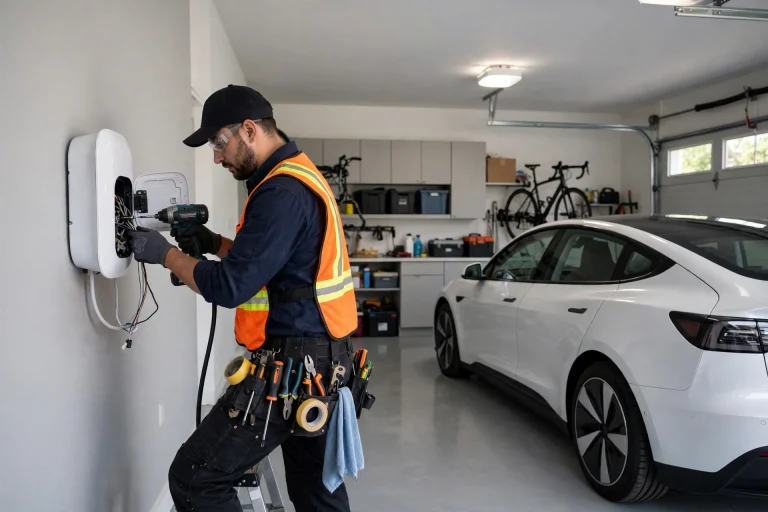
More Vancouver drivers are going electric, and most of them live in condos. That creates a practical problem: the car parks in a shared parkade, the electricity comes through a shared building service, and the parking stall is common property controlled by a strata corporation. Installing a Level 2 charger there follows different rules from wiring one into a detached house garage.
Three things decide whether your condo charger happens smoothly: strata approval, the building’s electrical capacity, and the City’s EV-ready rules. This guide explains how each one works and the order to do things in, so you can charge at home instead of planning your week around public stations.
Why a condo charger is a different job
In a detached house, the panel, garage and parking spot are all yours. In a condo, the parking stall is usually common property, the electrical service belongs to the building, and any new circuit runs through common areas: parkade ceilings, electrical rooms and conduit chases. A condo installation therefore involves three parties instead of one: you, your strata council, and a licensed electrical contractor. Capacity is the other difference: a house has its own service, often 100 or 200 amps, covering one household, while a condo tower has one building service shared by every suite, the parkade, the elevators, common lighting and, increasingly, dozens of EV chargers. Your charger has to fit inside that shared capacity, which is why load calculations and load sharing matter far more in a condo.
What “EV-ready” means under the City of Vancouver’s rules
Vancouver has required EV charging infrastructure in new buildings for years, under one of the strictest rules in Canada. Under section 4.14 of the City of Vancouver’s Parking By-law No. 6059, where parking is provided for dwelling uses in a new development, an energized outlet capable of providing Level 2 charging or higher must be installed in each parking space, excluding visitor parking. For non-residential uses, energized outlets are required in at least 45 percent of parking spaces; the current wording took effect on June 1, 2022.
That matters in two ways. If you are buying a new condo in Vancouver, your parking stall should already have an energized Level 2-capable outlet. Check the disclosure statement and look for the outlet or a labelled EV junction box at your stall before you assume you need a full installation.
If your building predates these rules, the bylaw does not reach back and rewire it. Older buildings have no automatic EV-ready infrastructure, and that is where the strata approval process and BC Hydro’s EV Ready rebates come in.
Strata approval: how the process works since December 2023
This is the part that has changed most. Amendments to BC’s Strata Property Act that took effect on December 6, 2023 made it significantly easier for owners to install EV charging, and set out a formal process both sides must follow.
First, the electrical planning report. Every strata corporation in BC with five or more strata lots must obtain one, assessing the building’s electrical system and its capacity for EV charging. For stratas in the Metro Vancouver Regional District, the deadline is December 31, 2026; for most of the rest of BC it is December 31, 2028. If your building has not obtained its report yet, ask your council where it stands: the report decides how much charging capacity the building has.
Second, the owner’s request. Once the strata has its electrical planning report, or that deadline has passed, an owner can formally request to install EV charging infrastructure for their own parking stall. Council must decide within three months, and the Strata Property Act says the strata corporation must not unreasonably refuse. The owner pays the installation cost, and council can require written agreement to reasonable conditions, for example the equipment type, the contractor, or how the electricity will be metered and billed.
Third, the voting thresholds changed. Spending from the contingency reserve fund on EV charging infrastructure, and approving a significant change in the use or appearance of common property for EV charging, now need only a majority vote instead of three-quarters. Special levies for EV charging still require a three-quarters vote.
A council can still say no for a genuine reason, and the example the Province itself gives is that the building’s electrical system does not have the capacity to support the charger. What a council cannot do is refuse for vague reasons, stall indefinitely, or apply a blanket policy against EV chargers. Unresolved strata disputes in BC go to the Civil Resolution Tribunal.
What to put in your request to council
A request that gets approved quickly answers the council’s questions before they are asked. Include your contact information and strata lot number, the charger specification and where it will be installed, the cable route from the electrical room to your stall, a load calculation showing the charger fits the building’s capacity, confirmation that a licensed electrical contractor will do the work and take out the permit, and a metering and billing proposal so the strata can recover the electricity cost fairly. If your building has an electrical planning report or an EV Ready plan, show how your installation fits within it.
Load sharing: how one building service charges many cars
The fear most strata councils have is simple: if twenty owners each install a 40-amp charger, the building service will be overloaded. Load sharing is the answer, and it is how most Vancouver condo buildings are solving this.
A Level 2 charger runs on 240 volts; a common 32-amp unit delivers about 7.7 kW, adding roughly 40 to 50 kilometres of range per hour. Under the Canadian Electrical Code, EV charging is a continuous load, so the circuit must be rated at 125 percent of the charger’s output: a 32-amp charger goes on a 40-amp circuit, a 40-amp charger on a 50-amp circuit, and a 48-amp charger on a 60-amp circuit.
An EV energy management system, often called load sharing, watches the building’s total demand and slows or pauses charging when the building is drawing heavily, then ramps it back up when demand falls. The Canadian Electrical Code permits this approach, and it lets a building with limited spare capacity support many chargers without a service upgrade. Because cars sit parked overnight for eight to twelve hours, a charger running at a managed, lower output still delivers a full battery by morning for most drivers.
That is why the load calculation comes before the charger purchase. It establishes how much capacity the building genuinely has, whether load sharing is needed, and what charger size makes sense for your vehicle and your driving. If the calculation shows the building truly has no room, a panel or service upgrade is the longer-term answer, but in most condo buildings managed charging closes the gap.
Permits and inspection in Vancouver
Every new EV charger circuit in BC needs an electrical permit, and Vancouver is one of the municipalities that issues its own electrical permits and does its own inspections, rather than routing them through Technical Safety BC. Your contractor takes out the permit under their licence, the work is inspected, and the inspection record is tied to a licensed electrical contractor. That record matters when you file an insurance claim, apply for a rebate, or sell your unit. Skipping the permit can leave you with an unchecked installation and a refused rebate application.
BC Hydro rebates for Vancouver condo buildings
The CleanBC Go Electric EV Charger Rebate Program, administered by BC Hydro and funded by the Province of BC, has a stream specifically for apartment, condo and townhome complexes with five or more units. Pre-approval from BC Hydro is required before any work starts.
The current offers for multi-unit residential buildings are: up to 75 percent of the cost of an EV Ready plan, to a maximum of $3,000; up to 50 percent of the cost of EV Ready infrastructure, to a maximum of $600 per parking stall and $120,000 per complex; and up to 50 percent of the cost of networked Level 2 chargers installed under an EV Ready plan, to a maximum of $1,400 per charger and $14,000 per complex. A standalone charger rebate of up to $2,000 per charger, to a maximum of $14,000 per complex, is available for buildings that have completed an EV Ready plan, Opportunity Assessment or electrical planning report. Across the three streams, a complex can receive up to $137,000 in total funding.
Rebate amounts and funding availability can change, so confirm the current program terms on BC Hydro’s website before your strata commits to a project. For an individual owner, the building-level rebates are usually the route: they are designed for exactly this situation, and they are why many Vancouver stratas are doing a building-wide EV Ready plan instead of approving one-off installations.
The step-by-step path from first enquiry to first charge
- Check your stall for an existing energized outlet or a labelled EV junction box, and check your building’s age against the City’s EV-ready rules.
- Ask your council about the electrical planning report, due December 31, 2026 for Metro Vancouver stratas: it sets the capacity picture for the whole building.
- Get a load calculation from a licensed electrical contractor: it decides the charger size and whether load sharing is needed.
- Submit a formal written request to council with the charger specification, cable route, load calculation, permit plan and metering proposal.
- Once approved, your contractor takes out the electrical permit with the City of Vancouver, installs the charger and has it inspected.
- Apply for any BC Hydro rebates, with pre-approval in place before work begins, and keep the itemized invoice the rebate application asks for.
Why condo charger requests stall, and how to avoid it
Most delays come from the same few mistakes: buying the charger before getting strata approval, then discovering the building cannot support it; submitting a request with no load calculation, which leaves council with nothing to approve; skipping the electrical planning report question, so nobody knows the building’s real capacity; proposing no metering or billing arrangement, which makes council worry about who pays for the electricity; and starting work before BC Hydro pre-approval, which can cost the building its rebate.
Frequently asked questions
Can my strata refuse my EV charger request in Vancouver?
Since the December 2023 amendments to the Strata Property Act, a strata corporation must not unreasonably refuse an owner’s properly made request to install EV charging infrastructure. Council can refuse for a genuine reason, such as the building’s electrical system not having the capacity, and it can set reasonable conditions. It cannot refuse for vague reasons or apply a blanket no-EV-chargers policy, and it must decide within three months of receiving the request.
Do I need strata approval if my stall already has an EV-ready outlet?
In a newer Vancouver building, your stall may already have an energized outlet capable of Level 2 charging under the City’s Parking By-law. You may still need strata approval to install the charger unit itself, connect it, and arrange metering and billing, because the work affects common property. Check your strata’s bylaws and ask council first.
How long does strata approval take?
Once you submit a formal request, council must decide within three months. In practice, a complete request with a load calculation, charger specification and metering proposal is usually decided much faster, often at the next council meeting.
What rebates can a Vancouver condo building get for EV charging?
Under BC Hydro’s EV Ready program for buildings with five or more units: up to $3,000 for an EV Ready plan, up to $600 per stall (maximum $120,000 per complex) for infrastructure, and up to $1,400 per charger (maximum $14,000) for networked Level 2 chargers, totalling up to $137,000 per complex. A standalone charger rebate of up to $2,000 per charger is also available, and pre-approval is required before work starts.
Who issues the electrical permit for a condo EV charger in Vancouver?
The City of Vancouver issues its own electrical permits and carries out its own inspections. Your licensed electrical contractor takes out the permit under their licence and arranges the inspection.
Conclusion
Installing a Level 2 charger in a Vancouver condo takes more planning than in a detached house, but the path is now clearer than ever: the City’s EV-ready rules cover new buildings, the Strata Property Act gives owners a formal request process with a three-month decision clock, load sharing lets one building service charge many cars, and BC Hydro’s EV Ready rebates can fund the building-wide work. Start with the load calculation and the conversation with your council, and the rest follows.
If you own a condo in Vancouver and want to charge at home, Intel Power Electric can help with the assessment, the load calculation and the documentation your strata council needs. See our EV charger installation in Vancouver page for condos and strata buildings, or read more about EV charger installation across the Tri-Cities and Metro Vancouver.
Sources: City of Vancouver Parking By-law No. 6059, section 4.14 (as amended by By-law No. 13075, in force June 1, 2022); Government of BC, “Electric vehicle charging in strata corporations”; BC Hydro, “Electric vehicle charger rebate program for multi-unit residential buildings”; Canadian Electrical Code (continuous load and EV energy management provisions).